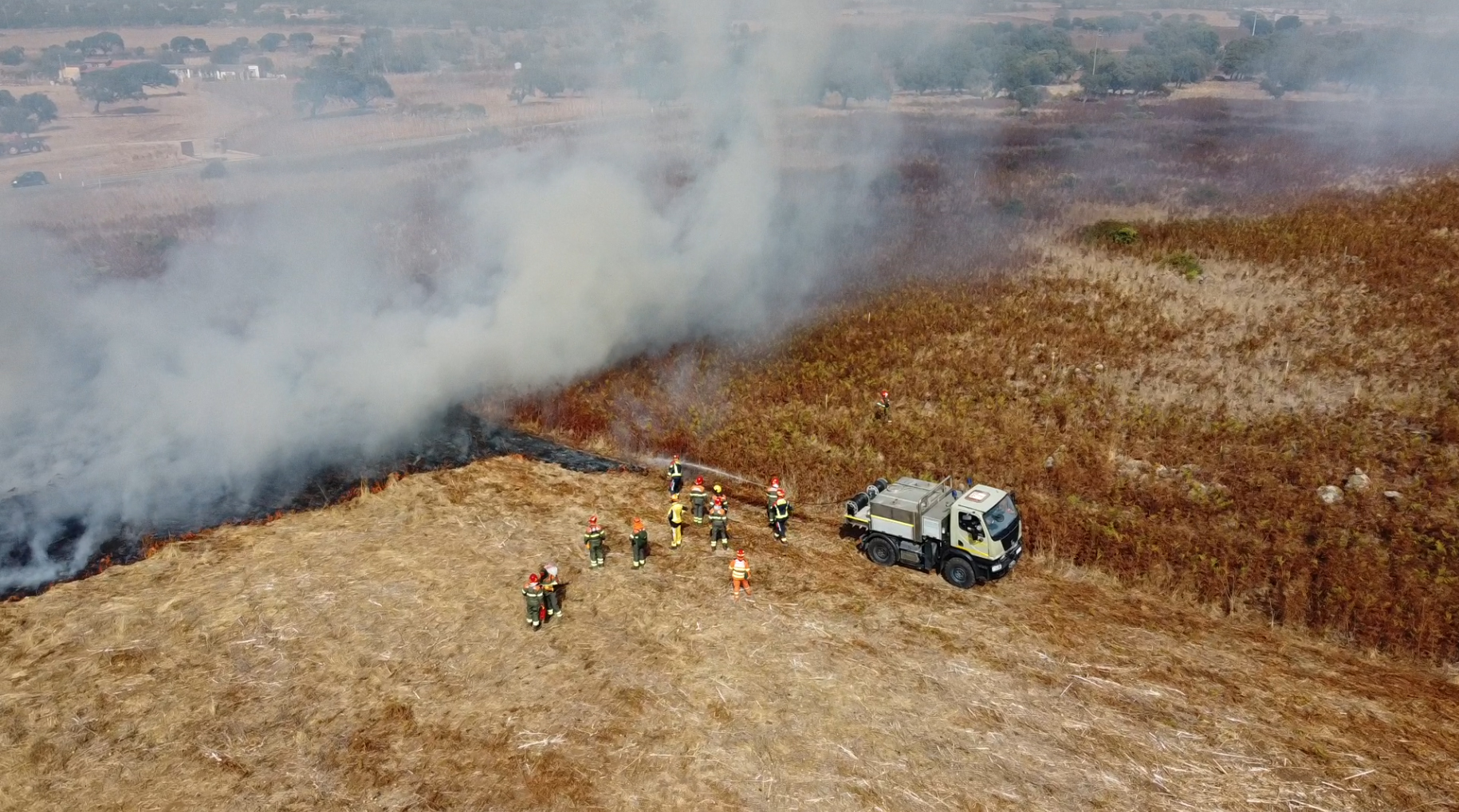
From September 9 to 11, 2026, Sardinia will host the second FIRESAFENET Study Visit, a project co-funded by the European Union under the Interreg VI-A Italy-Slovenia Program. The initiative is organized by ISIG—the Institute of International Sociology in Gorizia—in collaboration with its partner organizations : the National Research Council—Institute for Bioeconomics (CNR-IBE) and the Forestry and Environmental Surveillance Corps of the Autonomous Region of Sardinia (CFVA).
The delegation from Slovenia and Friuli-Venezia Giulia will consist of 25 people: researchers and representatives of research institutions; firefighters and representatives of the Italian and Slovenian forestry services; representatives from national, regional, and local civil protection agencies; representatives from the Slovenian Ministry of Agriculture, Forestry, and Food, the municipalities of Monfalcone and Ajdovščina, and other organizations involved in fire and emergency prevention and management.
Over the course of the three days, the delegation will be joined by participants from Sardinia, including representatives from the CFVA, Civil Protection, the CNR-IBE, and the Fire Analysis and Use Groups (GAUF). In total, the study visit will involve over 100 people and provide a concrete opportunity to share knowledge, best practices, and operational methods for the prevention and management of wildfires.
Preparing together for risks that know no borders
The wildfires that affected the Italian and Slovenian border regions in 2022 clearly demonstrated how environmental emergencies can quickly cross administrative boundaries and how important it is to be able to rely on an established framework of cooperation among regions, institutions, and response teams.
This experience has highlighted the need to make cooperation between Italy and Slovenia even more responsive, coordinated, and effective.
It is within this context that FIRESAFENET fits in— a project dedicated to developing innovative solutions for fire prevention, risk management, and the mitigation of the effects of climate change in the cross-border area.
The goal is to help build a genuine cross-border cooperation network capable of supporting local areas and responders in preparing for and responding not only to wildfires but also to other natural disasters.
Effective collaboration means getting to know one another before an emergency strikes, sharing procedures and experiences, bringing together different areas of expertise, and creating the conditions necessary to respond in a coordinated manner when the community is put to the test.
Why Sardinia: learning from a region with extensive experience in fire management
The decision to hold the study visit in Sardinia stems precisely from the region’s long and well-established experience in the prevention, study, and management of wildfires.
It is a context in which scientific research, monitoring, prevention, and operational response have, over time, developed highly valuable expertise—thanks in part to the collaboration between the regional firefighting system, the Forest Service, Civil Protection, the Fire Analysis and Management Groups (GAUF), local authorities, and the research community.
The study visit therefore provides an opportunity to gain firsthand insight into the methodologies, tools, and experiences developed in Sardinia and to share useful insights for strengthening cooperation in the Italy-Slovenia cross-border region.
It is not just a matter of following best practices, but of fostering direct dialogue among regions that, despite their different characteristics, share the need to prevent risks, protect the environment, and improve their ability to respond to fires.
The Study Visit program
The first day, hosted atthe CNR Research Center in Sassari and organized by CNR-IBE, will be dedicated to scientific discussions and an update on the progress of FIRESAFENET.
Topics covered include the characterization of fuels using laser scanning technologies, the estimation of emissions from wildfires, fire propagation modeling, monitoring fuel moisture, future climate scenarios, and monitoring biodiversity after wildfires.
On the second day, the program will continue in the Goceano woods, with activities organized by CNR-IBE, where participants will have the opportunity to observe firsthand methodologies and practices related to fire ecology, moisture monitoring, fuel management, and field research.
The final day of the event, on September 11, in the Suni area, will be organized by the Forestry and Environmental Protection Corps of the Autonomous Region of Sardinia (CFVA), with the participation of the Fire Analysis and Use Groups (GAUF), Civil Protection, and other participating entities. The first part will be dedicated to presentations and a technical-operational exchange of experiences gained in Sardinia, Friuli-Venezia Giulia, and Slovenia.
The technical and operational workshop will be followed by field activities focused on the prevention and management of wildfires, offering participants the opportunity to gain a deeper understanding of the methods and procedures used in different regions.
The transition from comparing experiences to operational activities will be one of the central elements of the Study Visit: connecting knowledge, procedures, and practices developed in different contexts, and identifying elements that can help make cross-border collaboration more effective.
ISIG’s role: building cooperation before emergencies strike
By organizing the Study Visit, ISIG fosters dialogue between research, practical expertise, and local experiences, helping to strengthen collaboration between Italy and Slovenia in risk prevention and management.
The Study Visit, along with FIRESAFENET’s other activities, will also help lay the groundwork for the development of a Virtual Training Center platform, which will be coordinated by ISIG. This tool is designed to share the knowledge, experiences, and solutions developed through the project and to support the joint training of the stakeholders involved.
An initiative aimed at making cross-border cooperation more structured and effective, while strengthening the resilience of local communities, protecting natural and cultural heritage, and ensuring the safety of the population.
FIRESAFENET is co-funded by the European Union under the Interreg VI-A Italy-Slovenia Program.