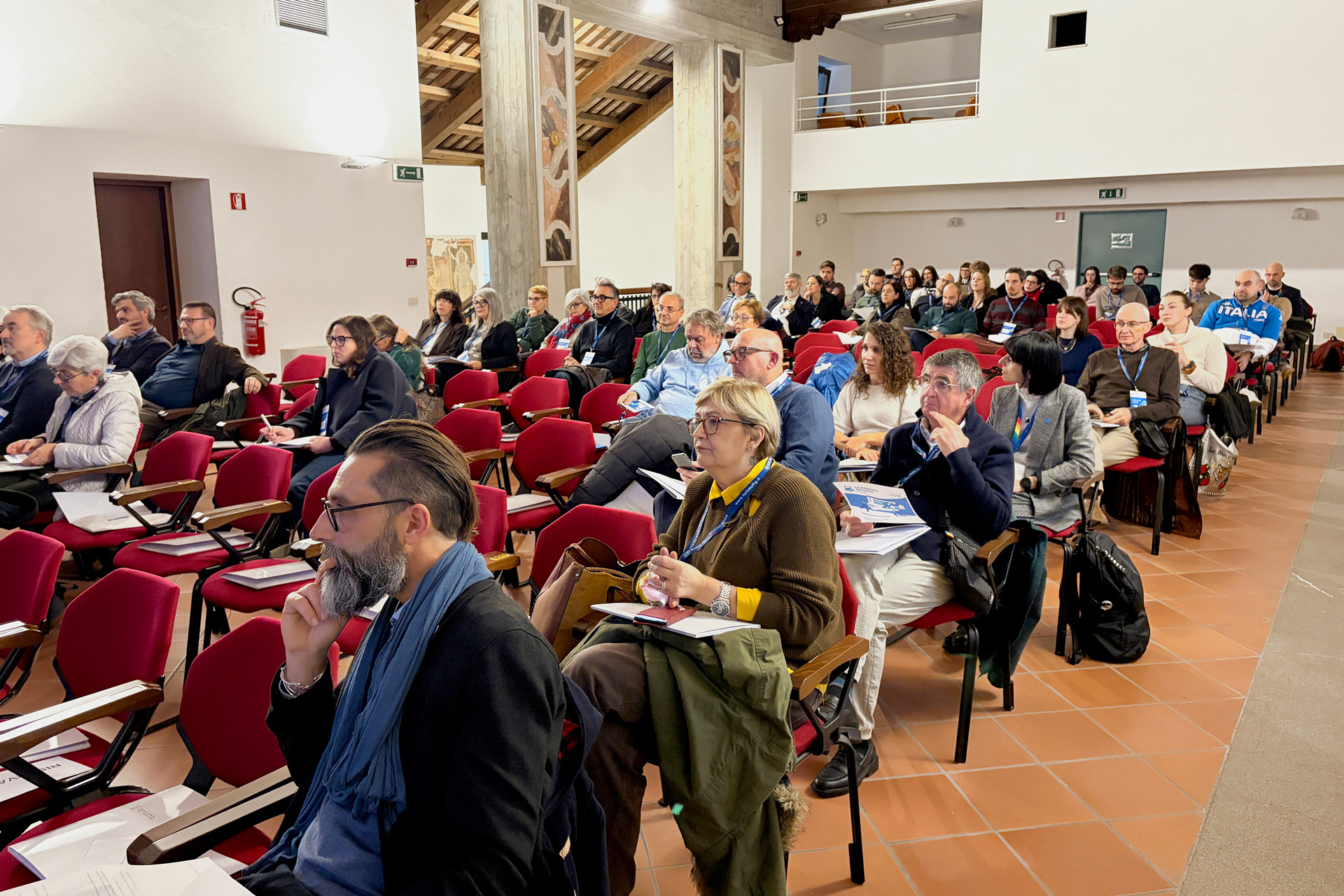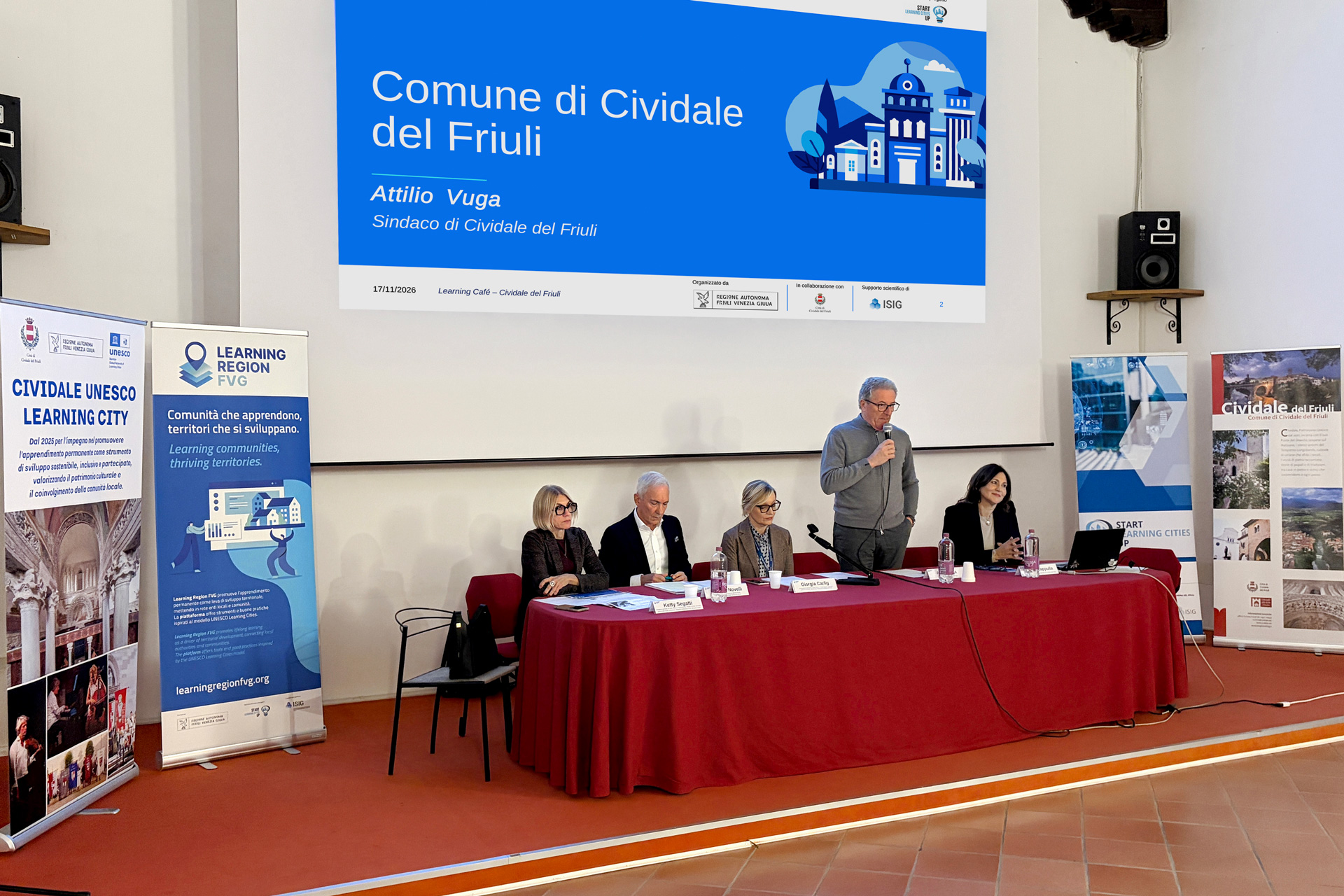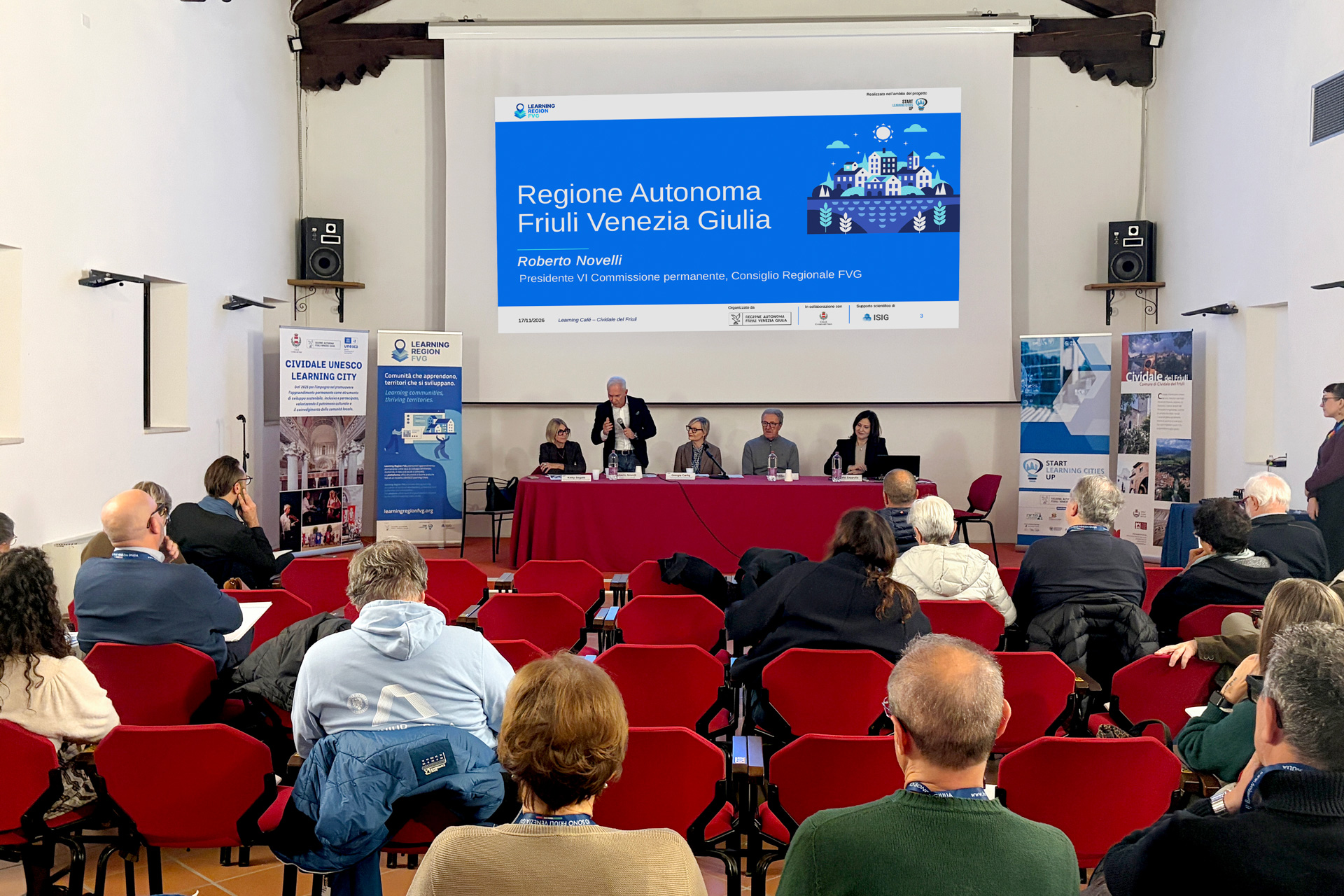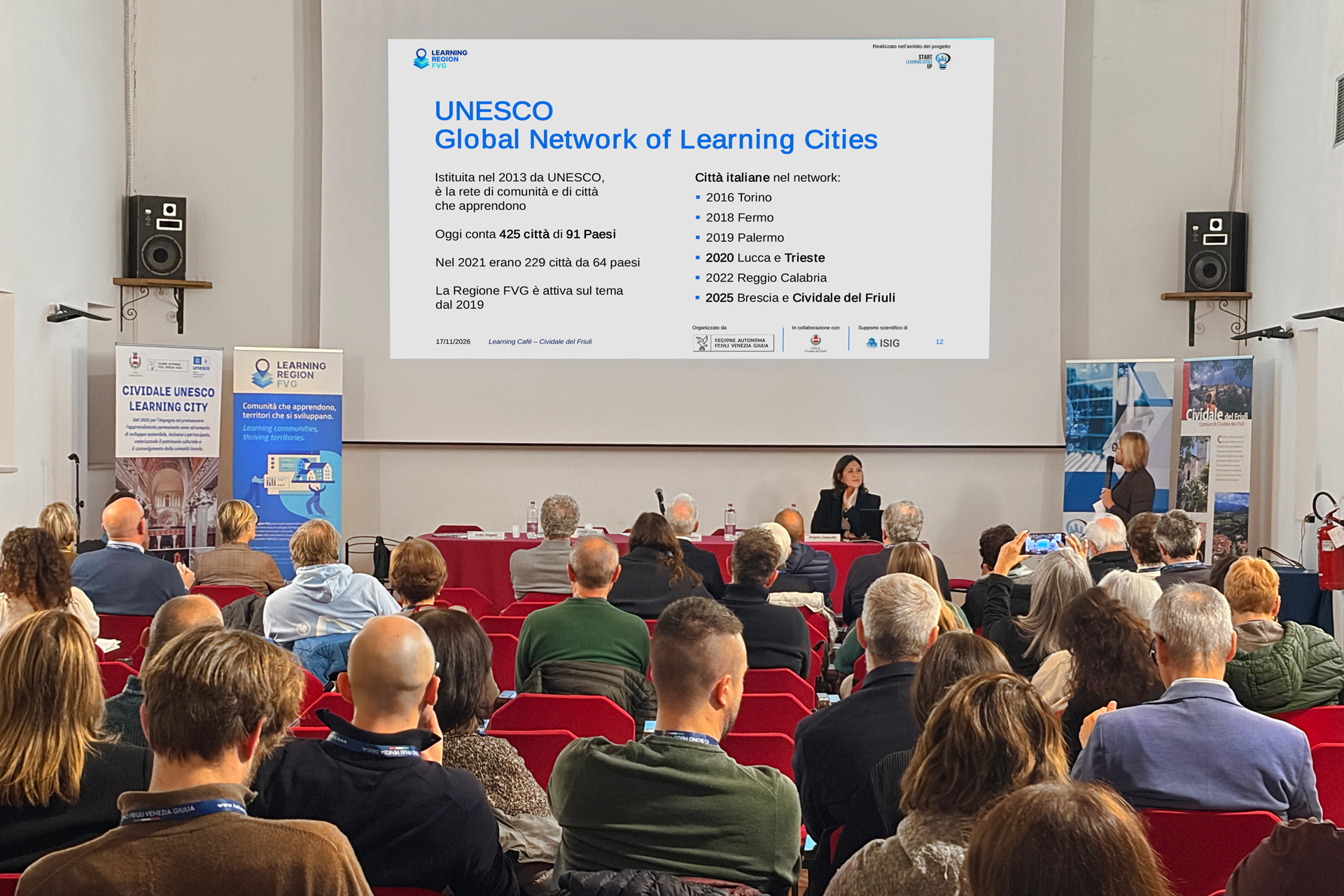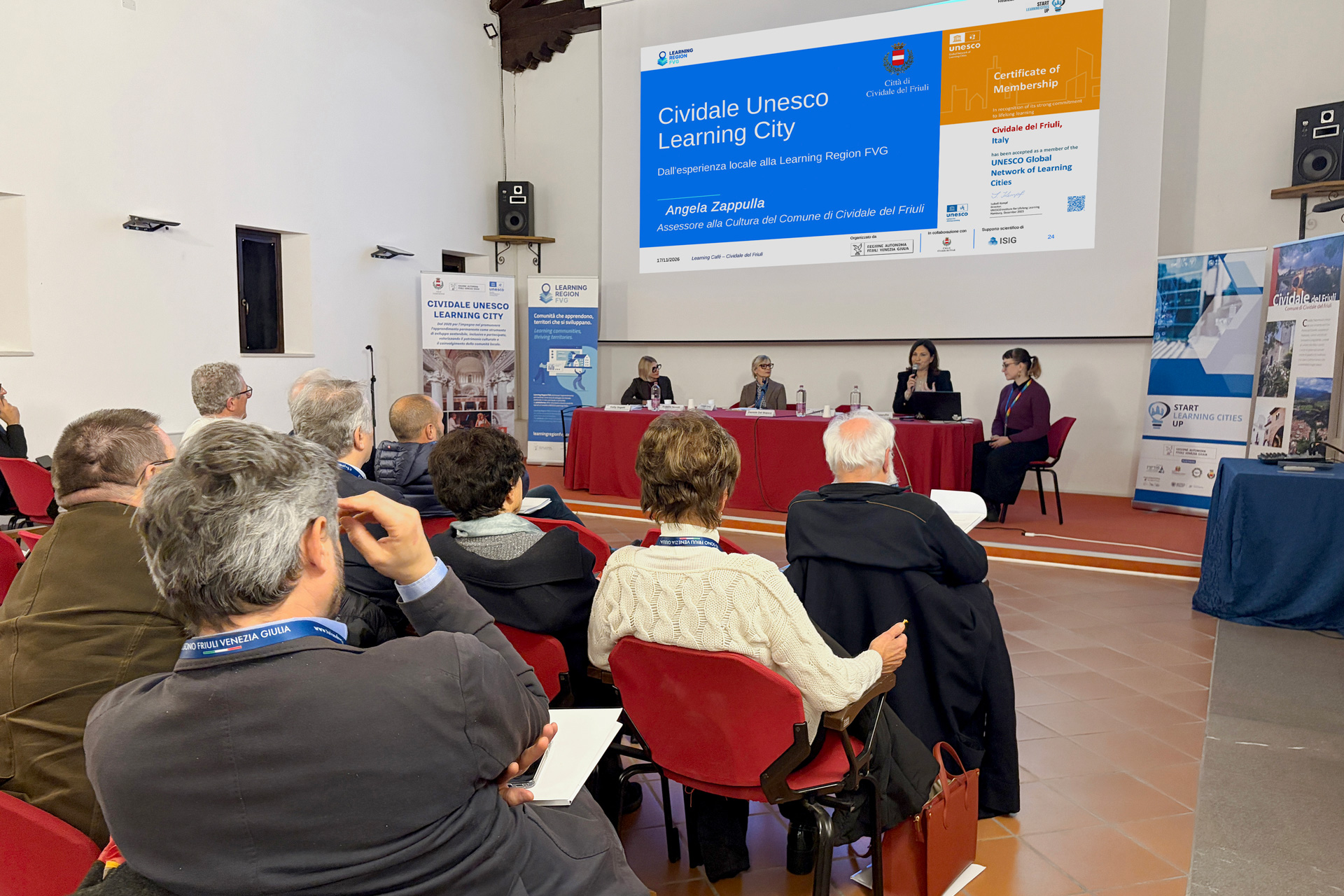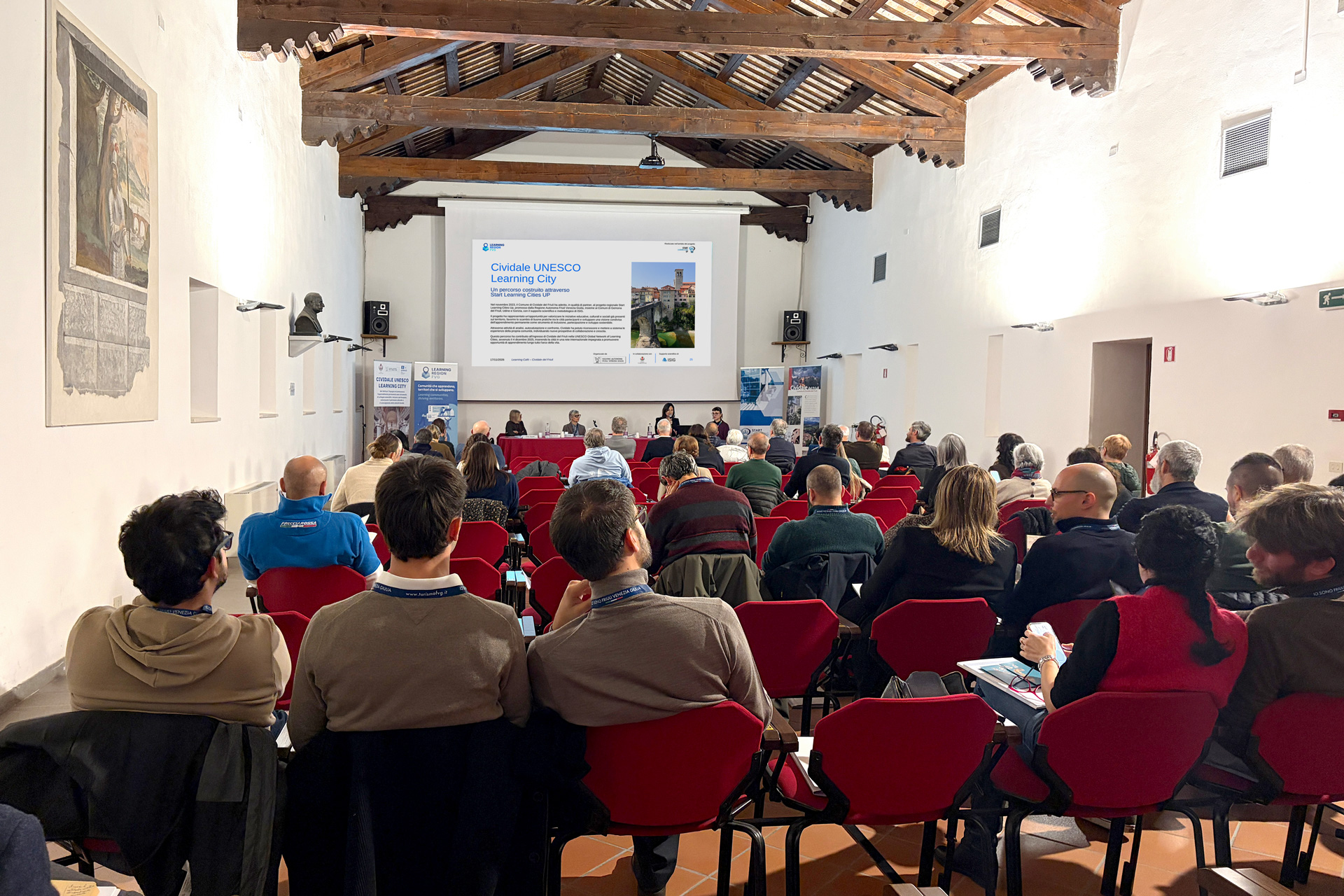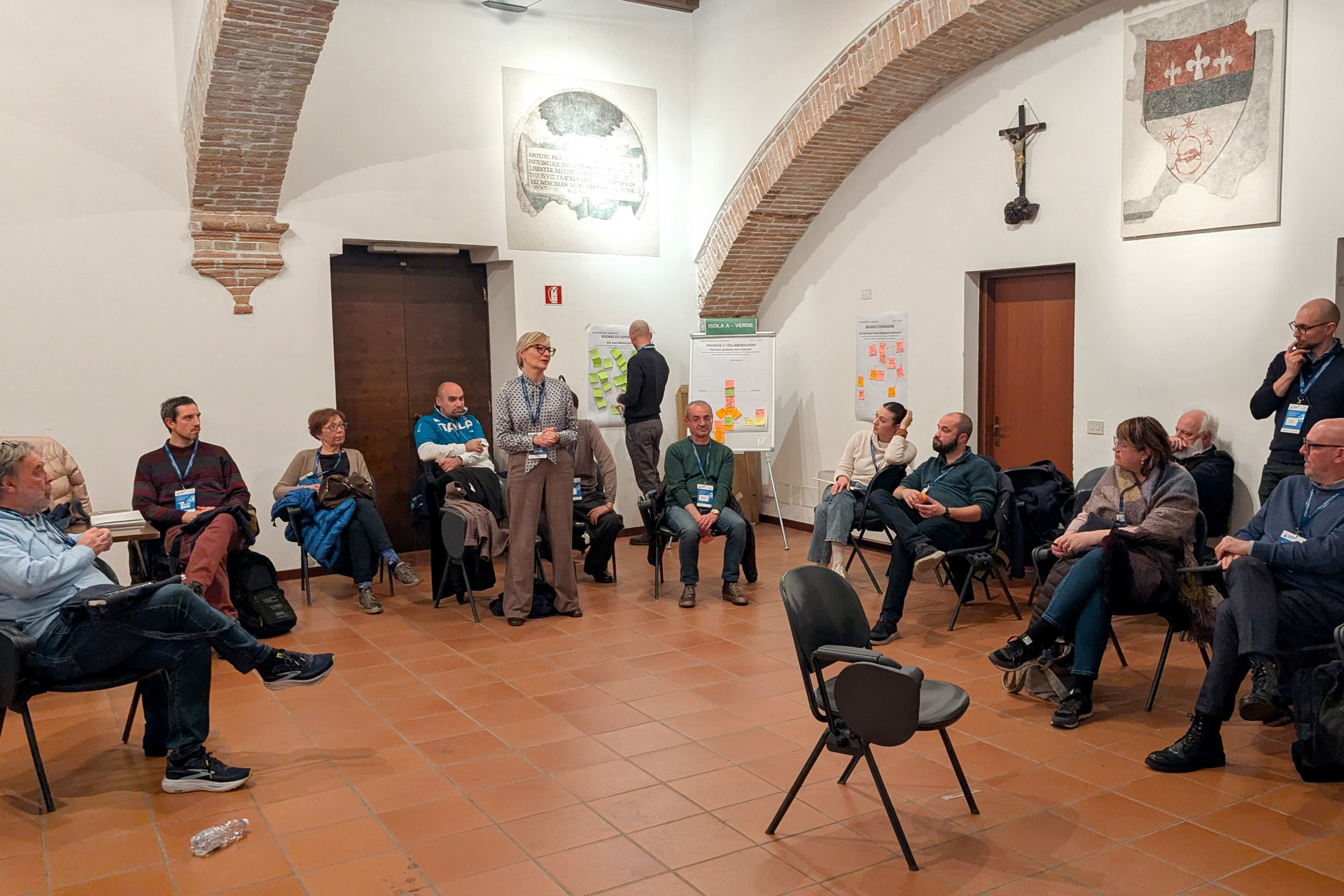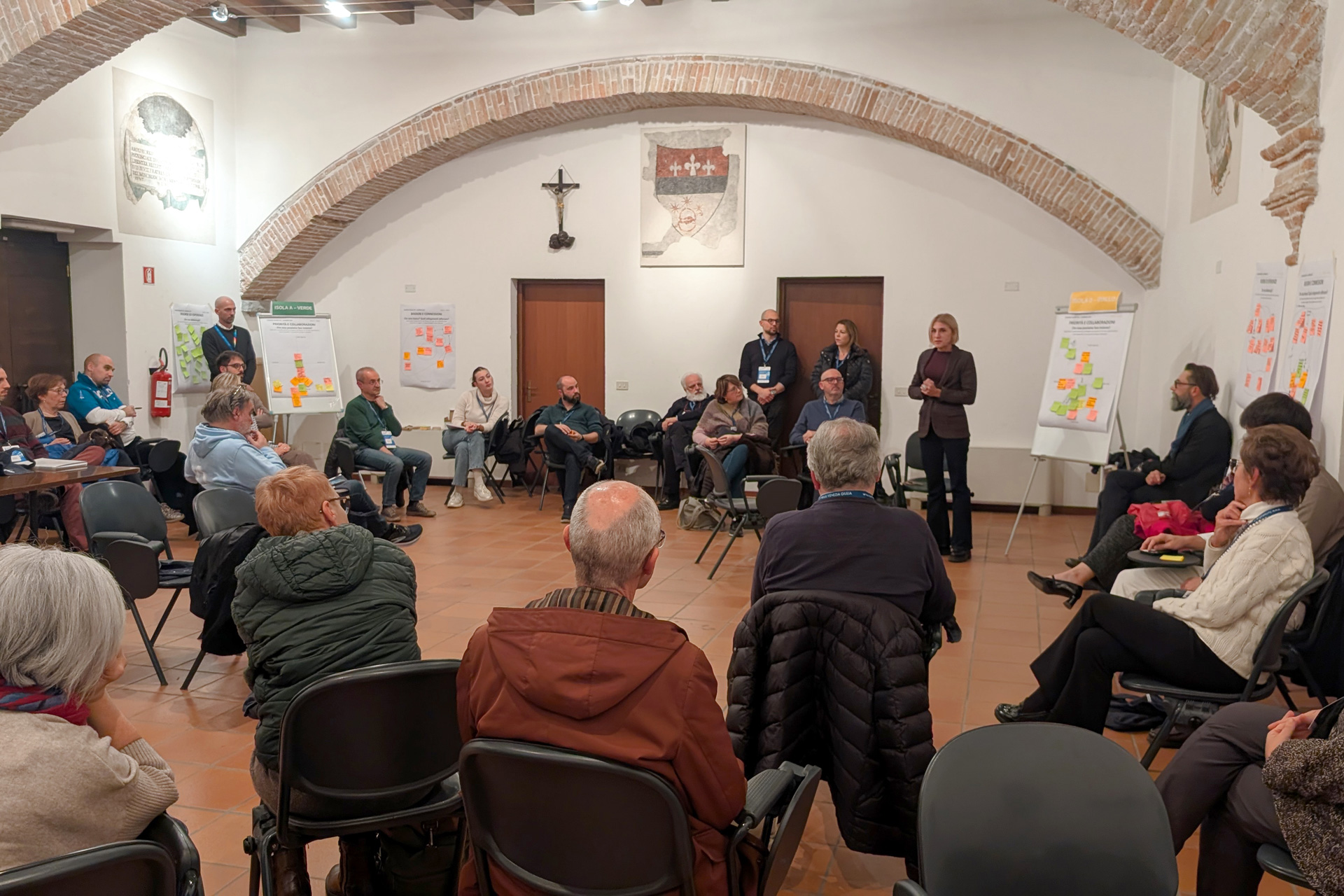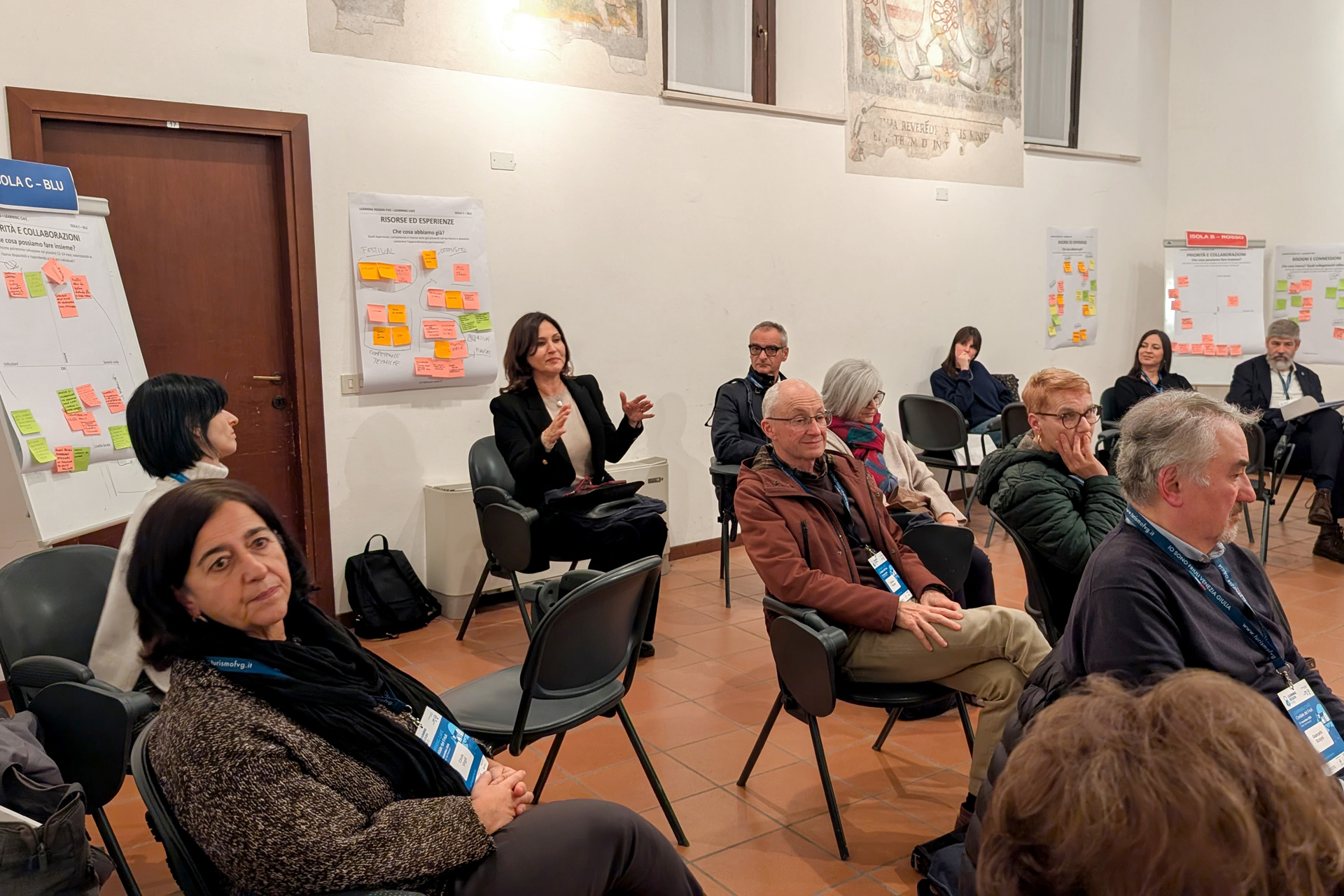
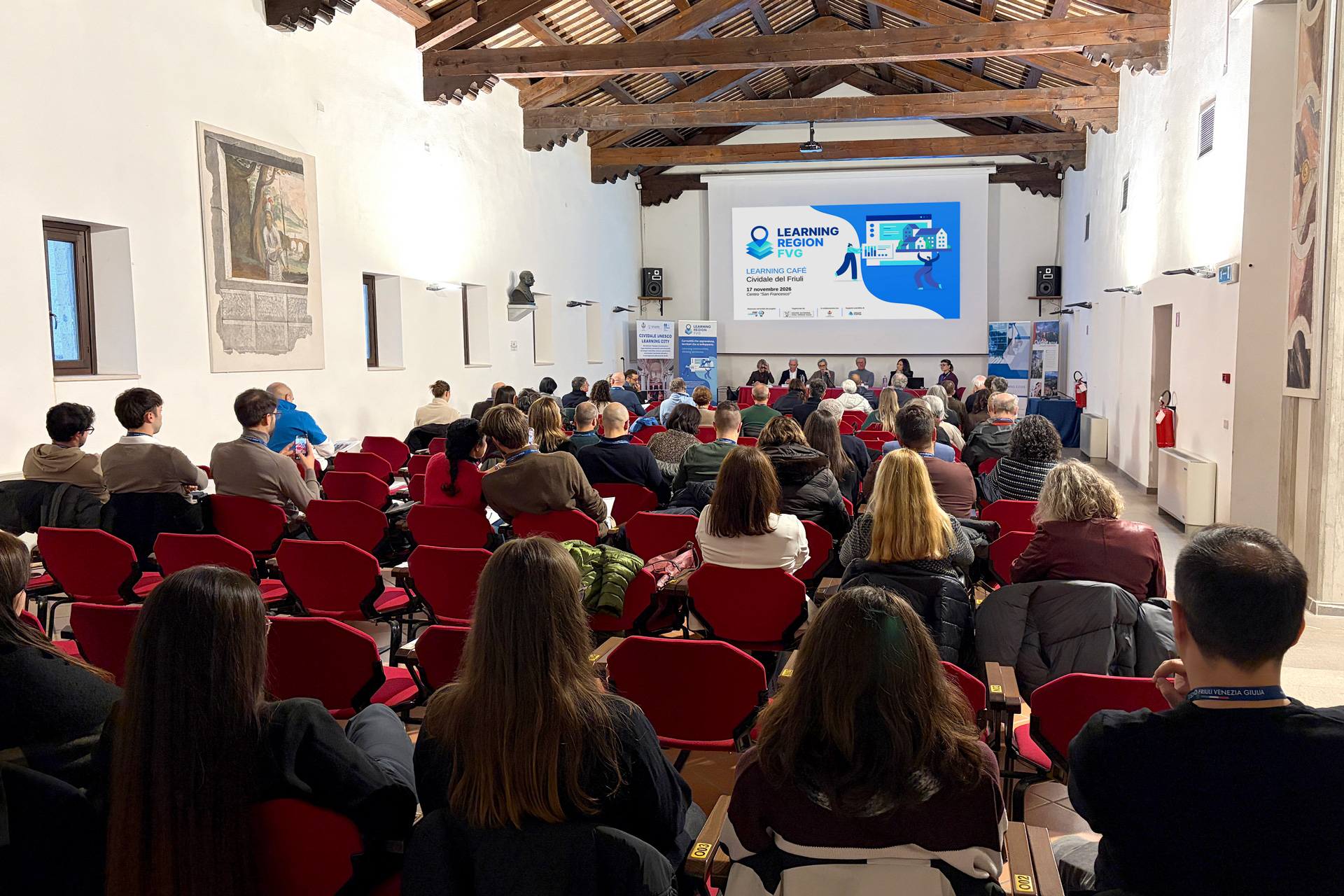
On November 17, 2026, the “San Francesco” Center in Cividale del Friuli hosted the Learning Café – Cividale del Friuli, an afternoon of discussion dedicated to the role of cities and communities in promoting lifelong learning, exploring regional policies, local experiences, and new avenues for collaboration.
The event, organized by ISIG —the Institute of International Sociology in Gorizia—in collaboration with the Autonomous Region of Friuli-Venezia Giulia and the Municipality of Cividale del Friuli, brought together institutional representatives, local officials, associations, professionals, and local stakeholders with the goal of highlighting the process that led to Cividale’s admission, in December 2025, into the UNESCO Global Network of Learning Cities and to explore the opportunities offered by the Learning Region FVG project.
The initiative consisted of two complementary parts: a public conference, dedicated to the significance of Learning Cities and regional policies for lifelong learning, and a participatory workshop, designed and facilitated by ISIG, to directly engage stakeholders in reflecting on the future of the city.
Learning Cities: Institutions and Communities in Dialogue
The first session, titled “Learning Cities: Cities and Territories That Learn,” was opened and moderated by Giorgia Carlig, Councilor for the Environment, Governance, and Territorial Cooperation, European Policies, and Smart City for the Municipality of Cividale del Friuli.
In his opening remarks, Carlig highlighted the significance of the city’s UNESCO recognition, describing it as “an important milestone, but above all a starting point.” This achievement was the result of a collaborative effort launched in 2023 as part of the regional STARTLCUP – Start Learning Cities UP project, which helped highlight the wealth of educational, cultural, and social experiences within the Cividale community.
The Mayor of Cividale del Friuli, Attilio Vuga, delivered the official remarks, emphasizing the importance of local organizations’ participation in ensuring continuity and practical application of the principles of lifelong learning. The mayor also acknowledged the commitment of Councilors Giorgia Carlig and Angela Zappulla in the process leading up to the UNESCO recognition, thanking ISIG for its scientific and methodological contribution.
Next, Roberto Novelli, Chair of the Sixth Standing Committee of the Friuli Venezia Giulia Regional Council, conveyed greetings from Regional Councilor Alessia Rosolen, highlighting the value of cultural, scientific, and social connections as a driver of community growth and the importance of building partnerships capable of generating lasting opportunities for local communities.
ISIG’s Contribution: From Learning Cities to Community Participation
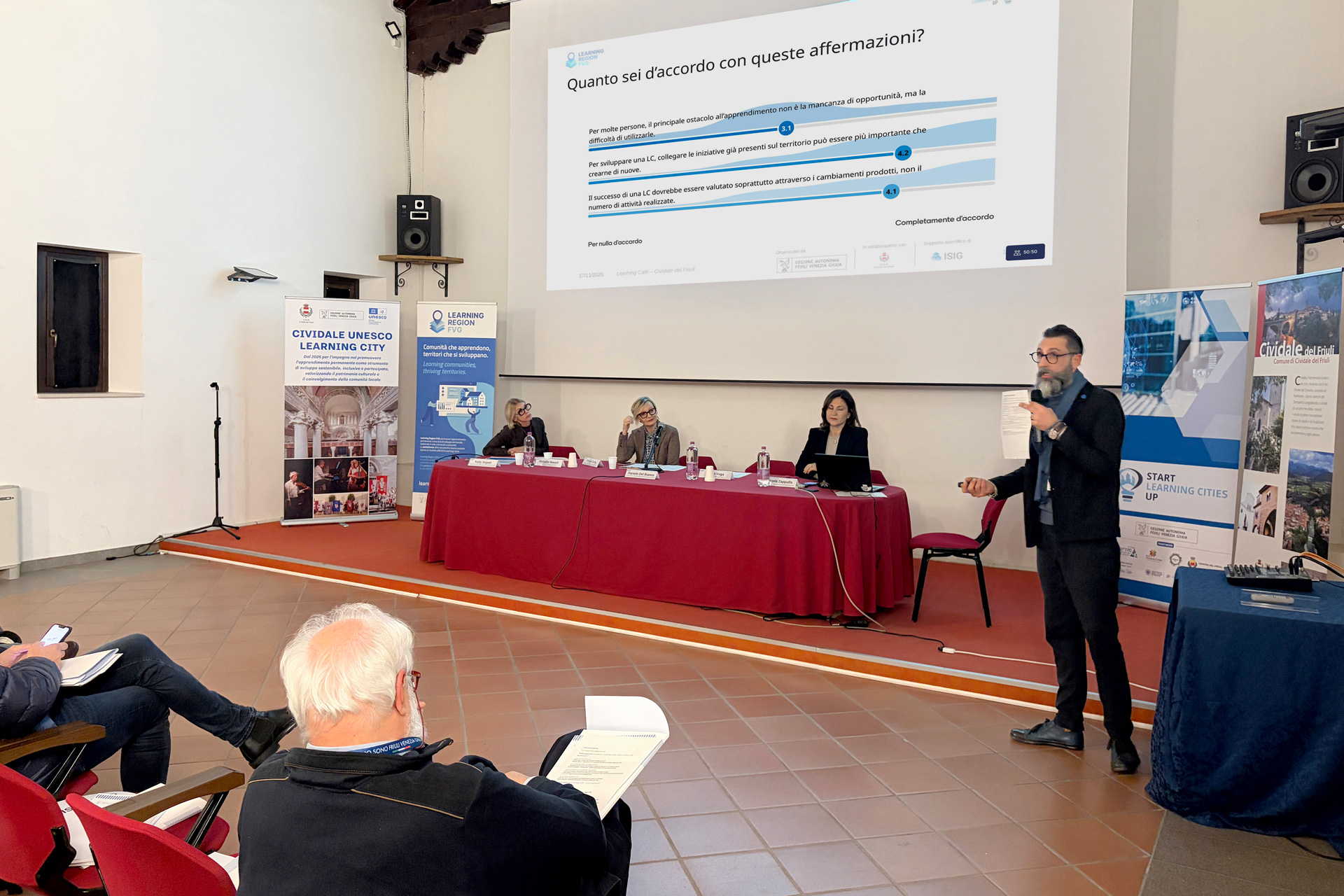
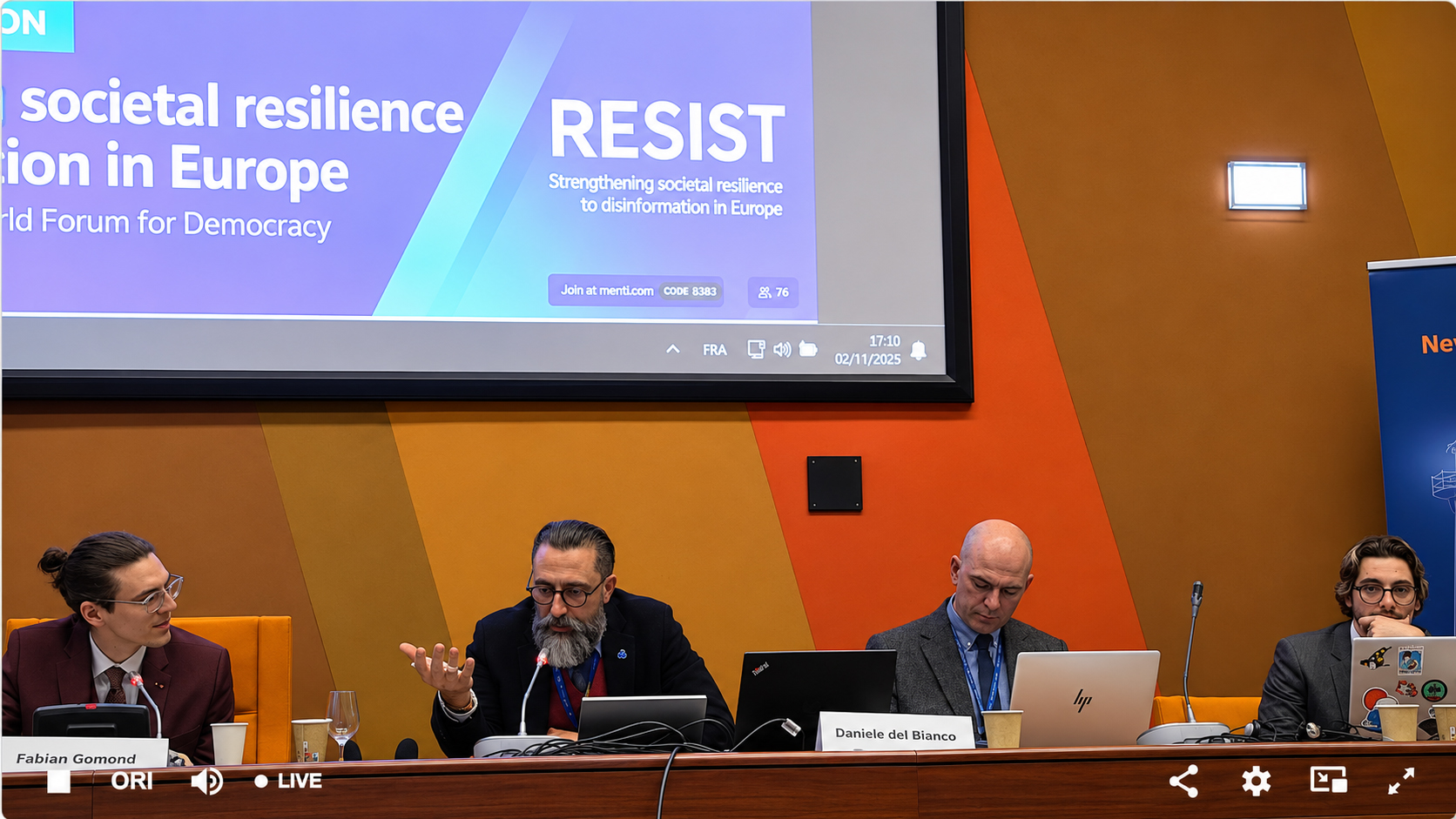
The first in-depth presentation of the conference was given by Daniele Del Bianco, Director of ISIG, who outlined the international “Learning Cities” model promoted by UNESCO, emphasizing that lifelong learning is not limited to educational and training programs but encompasses the entire life of communities through cultural, community, professional, and social experiences.
The presentation featured moments of direct interaction with the audience via a dedicated Mentimeter, a digital tool that allowed participants to contribute in real time to the collective discussion on the meaning of a learning city.
Through questions and brief interactive activities, attendees were invited to share keywords, express their views on learning opportunities, and envision what concrete changes might shape Cividale in the coming years.
The responses highlighted concepts such as learning, culture, community, participation, and innovation, along with reflections on the importance of making the most of existing resources, strengthening connections between local entities, and making learning opportunities increasingly accessible.
Del Bianco placed particular emphasis on the need to move beyond a view of learning tied exclusively to the number of activities offered, and to focus instead on the changes and the concrete impact these activities have on the community.
This perspective echoes some of the fundamental elements of the UNESCO model: a shared strategy, participatory governance, the promotion of local resources, and monitoring tools capable of documenting the progress of learning cities.
The presentation also highlighted the opportunities offered by the regional platform “Learning Region FVG,” through digital tools for territorial analysis and self-assessment designed to support local governments and stakeholders in developing their lifelong learning strategies.
Learning Region FVG: The Regional Pathway and Future Prospects
Ketty Segatti, Central Director of the Research, Innovation, European Social Fund Plus, and Other EU Funds Unit (UOS) for the Autonomous Region of Friuli Venezia Giulia, elaborated on the regional perspective, illustrating the Region’s commitment to promoting lifelong learning as a strategic factor for the development of communities and territories.
Segatti traced the evolution of regional policies dedicated to Learning Cities, citing the experience of the STARTLCUP project — Start Learning Cities UP, launched in 2023, which assisted several municipalities, including Cividale del Friuli, in analyzing and enhancing their local learning ecosystems, with scientific and methodological support from ISIG.
A process that laid the groundwork for Learning Region FVG, the new regional initiative aimed at promoting the UNESCO model of learning cities, strengthening collaboration among local areas, and providing local governments and stakeholders with tools for analysis, self-assessment, and the sharing of best practices—all accessible through the online platform www.learningregionfvg.org.
In his remarks, Segatti also highlighted the contribution of regional training policies—including initiatives supported by the European Social Fund Plus—to the innovation of learning models.
Looking ahead to future developments, two strategic priorities were highlighted: technical and methodological support for regional Learning Cities in monitoring activities and results to be documented for UNESCO, with the contribution of ISIG; and strengthening the international dimension through the exchange of experiences and best practices with other European cities.
The conference then turned its attention back to Cividale’s experience through a presentation by Angela Zappulla, Councilor for Culture, who outlined the initiatives that contributed to the city’s UNESCO recognition.
From policies on sustainability and social inclusion to cultural and educational activities, Cividale has successfully promoted a diverse range of experiences rooted in the local community. Particular emphasis has been placed on three best practices that highlight the connection between heritage, traditions, and learning: educational activities related to the Tempietto Longobardo; the Palio di San Donato, as an experience of participation and the intergenerational transmission of traditions; and the international advanced music courses, which have been enlivening the city for nearly forty years.
The Learning Café: ISIG leads the workshop with local stakeholders
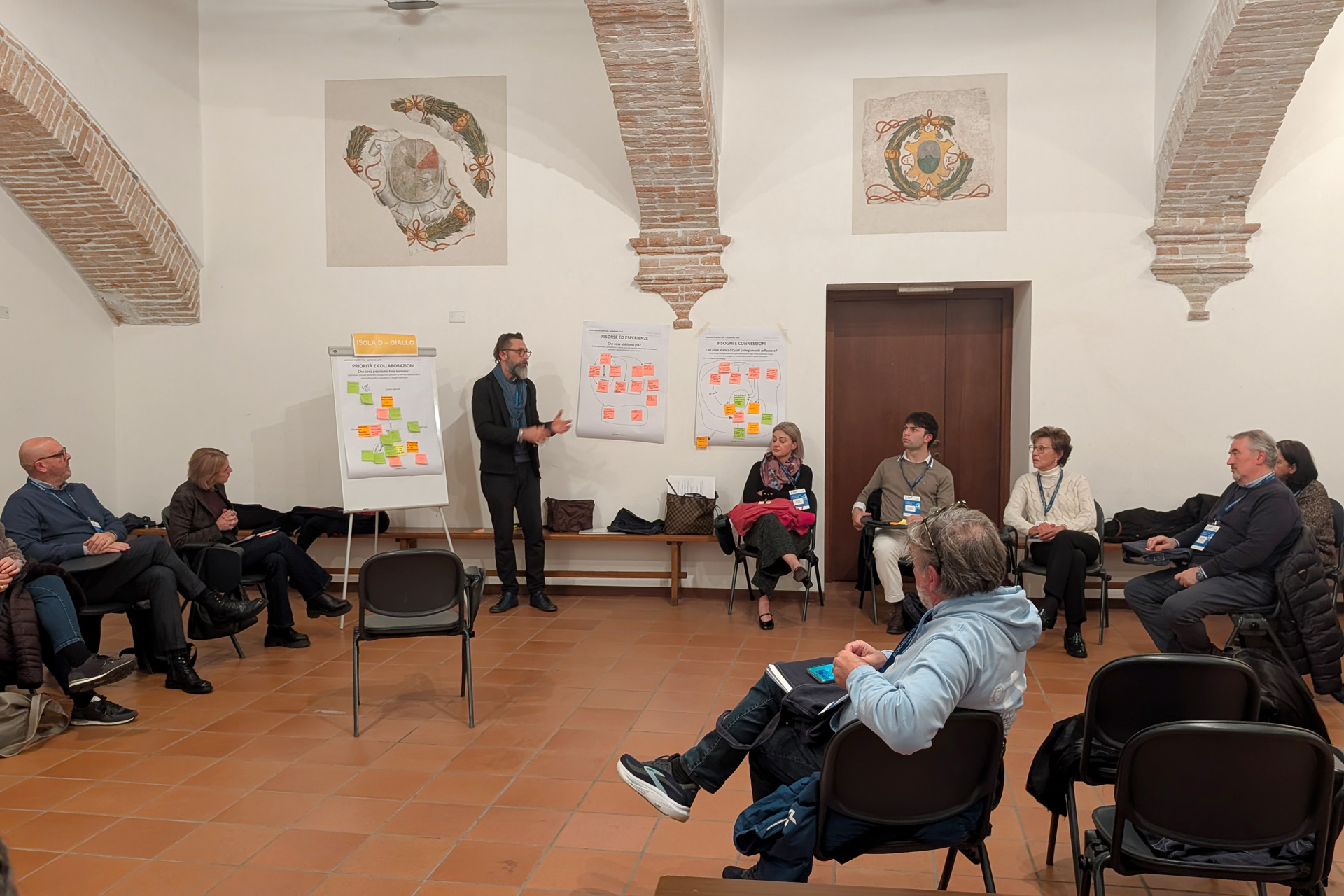
The second part of the event transformed the conference’s discussions into an opportunity for direct dialogue through the “Learning Café – Group Work, ” a participatory workshop designed and coordinated by ISIG using a methodology inspired by the World Café.
Forty stakeholders registered for the session, including representatives from associations, institutions, cultural organizations, and museums, as well as professionals and experts active in various areas of social life and regional development, primarily from Cividale del Friuli and the broader regional context.
Four ISIG facilitators led the session, which was organized into four discussion groups, guiding participants through a process of listening, dialogue, and sharing ideas. Through a rotation system among the groups, each participant had the opportunity to engage with different discussion partners, helping to progressively enrich the collective reflections.
The workshop centered on three main themes: the resources and experiences already present in the local area, the needs and connections to be strengthened, and potential priorities and future collaborations.
After identifying existing skills, initiatives, and learning opportunities, the discussion shifted to unmet needs and potential synergies among institutions, associations, and other local entities. The final phase invited participants to envision concrete actions to be developed in the coming years, leveraging existing resources and identifying new opportunities for collaboration.
Ideas were gathered and shared throughout the various working sessions, culminating in a collective presentation of the contributions developed by the four groups.
The workshop represented an initial experience in participatory listening and monitoring, building on the methodological framework developed by ISIG as part of STARTLCUP and the subsequent activities of the Learning Region FVG.
The contributions gathered will be organized by ISIG and made available to the Municipality of Cividale del Friuli and the Autonomous Region of Friuli Venezia Giulia as a knowledge base for subsequent activities involving analysis, regional collaboration, and the development of local policies for lifelong learning.
From Participation to New Perspectives on Collaboration
The Learning Café experience provided an opportunity to bring institutions and local organizations together, highlighting the role of participation in building communities capable of learning, innovating, and addressing the challenges of the future.
Through organizing the event, providing scholarly input to the conference, and facilitating the participatory workshop, ISIG supported this dialogue between institutions and stakeholders, helping to create the conditions for a shared reflection on Cividale’s prospects as a Learning City.
This initiative continues within the framework of the Learning Region FVG, with the goal of strengthening local networks, supporting the monitoring of UNESCO-recognized cities, and promoting new opportunities for collaboration and learning at the regional and international levels.